


Managing invoices is often time-consuming and prone to manual errors. Invoice processing automation reduces this complexity by eliminating manual keying and standardising how invoice data is captured and validated. Using AI with Microsoft Power Platform, organisations can automate invoice capture, data extraction, validation, and posting to the ERP—improving speed, accuracy, and auditability. This article outlines two approaches on Microsoft Power Platform for automated invoice processing, including what each option is best suited for.
Benefits of Automated Invoice Processing
- Efficiency: Invoice processing automation streamlines capture, extraction, and routing to reduce manual keying and speed up invoice throughput.
- Accuracy: AI-driven extraction reduces human error and improves the consistency of captured invoice fields.
- Integration: Connect invoice automation to your ERP and finance systems so approvals and postings happen in the same governed process.
Option 1: Microsoft’s Prebuilt Invoice Processing Solution
Microsoft provides a prebuilt approach for invoice processing automation, designed to streamline accounts payable workflows using Power Automate, AI Builder, and Dynamics 365 Finance. Below is how this invoice processing software works in practice.
How the Prebuilt Process Works
- Invoice collection: The process starts by collecting supplier invoices (typically PDFs) from a defined source. Invoices can be captured from a designated OneDrive folder or a monitored mailbox.
- AI extraction: AI Builder supports ai invoice processing by reading the invoice and extracting key fields for downstream processing. It typically extracts fields such as buyer and supplier details, invoice number and date, totals and taxes, and the due date (depending on configuration).
- Automated posting: If required fields meet validation rules and confidence thresholds, the flow creates the invoice record in Dynamics 365 Finance (with the exact method depending on your integration approach).
- Exception handling: If fields are missing or confidence is low, the invoice is routed to an exception queue for human review. Users can correct or complete missing fields in a Power Apps review screen and then submit the validated invoice for creation in D365 Finance.
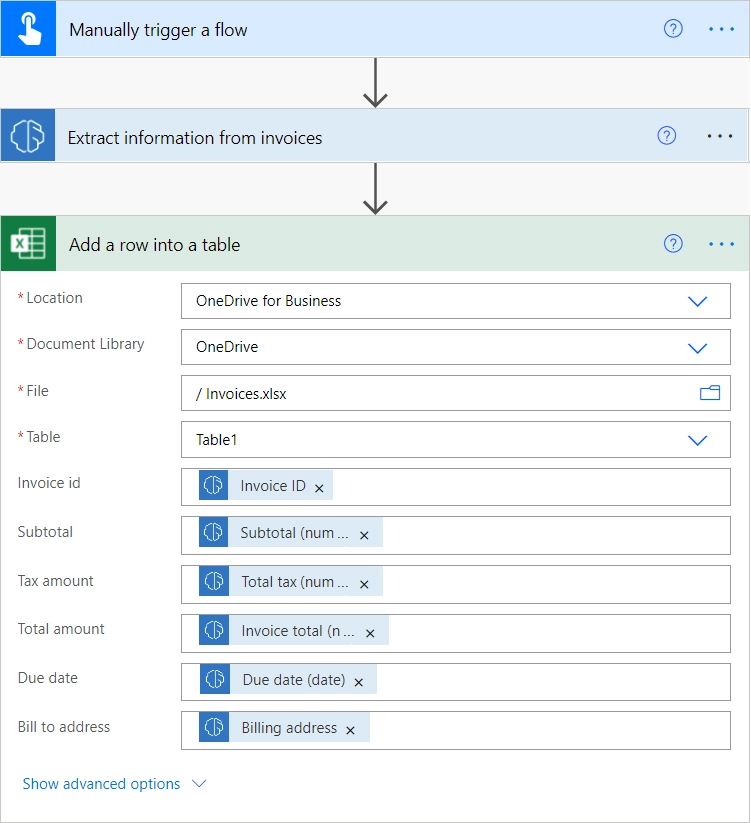
A typical flow follows a simple pattern:
- Capture invoices from a defined source (OneDrive or mailbox).
- Extract invoice fields using AI Builder.
- Apply validation rules and confidence thresholds.
- Route exceptions to a Power Apps review screen.
- Create the invoice record in Dynamics 365 Finance once validated.
The AI Builder prebuilt invoice model
At the core of this approach is the AI Builder prebuilt invoice model, which is designed to recognise common invoice layouts and fields. For many organisations, it provides a strong starting point for automating standard supplier invoices with minimal setup. Read more about prebuilt automatic invoice processing model here to review supported fields, setup steps, and typical configuration options.
Option 2: A Custom Power Automate + AI Builder Approach
If you have non-standard layouts, multiple languages, or higher variability across suppliers, a custom model can make invoice processing automation more accurate and easier to control. Here’s when—and how—to use a custom model.
Customisation options
- Prebuilt model (best for common layouts): If most invoices follow typical formats, the prebuilt model may be sufficient—regardless of whether you later add validation and exception handling. It works best when invoice layouts are consistent and field placement is predictable.
- Custom document model (best for high variability or localisation): If invoices vary by supplier, language, or country-specific fields, train a custom model for more reliable extraction. A custom model can improve extraction accuracy for localised formats (for example VAT fields, tax IDs, and region-specific layouts).
Which option should you choose?
Whether you start with the prebuilt model or a custom approach, automated invoice processing can reduce manual effort, improve control, and shorten your AP cycle time. The biggest gains in invoice processing automation come from combining extraction with validation, exception handling, and governed posting into your ERP. If you want to reduce invoice processing effort without weakening controls, start with a short pilot to measure extraction accuracy, touchless rate, and exception volume.


