


One of the sales team’s most important jobs is communicating efficiently with customers. With microsoft teams crm integration, sales and service conversations carry more context—but what actually changes day to day?
This article explains what Microsoft teams CRM enables and how it reduces context switching, delays, and handoff errors. You’ll see how to access dynamics 365 crm dashboards inside Teams, work with Dynamics 365 files during meetings, and link CRM records to Teams channels. You’ll also learn how embedded Teams Calling keeps calls, notes, and CRM records connected—and which Dynamics 365 apps support the integration.
Reduce workflow disruption with Microsoft teams CRM
Think about the time lost when you open an email or chat, hunt for the right record, reply, and then try to re-enter your workflow. Those small interruptions compound—and they’re why “simple” tasks often take far longer than they should.
To reduce those disruptions, bring processes, data, and communication into one integrated workspace. This saves time, improves collaboration, and keeps teams focused on customers instead of admin.
Key features of Dynamics 365 + Teams integration
For a deeper walkthrough, see Dynamics 365 and Teams integration; in short, it includes several features that reduce context switching and improve collaboration. This matters most when you’re working in dynamics 365 crm and want the same customer context to follow the conversation.
Here’s what the integration enables inside Teams and inside Dynamics 365.
In Microsoft Teams, you can:
- View your personal dashboard without leaving Teams.
- Work with Dynamics 365 files during Teams meetings.
- Manage documents and files in context, linked to the right CRM record. Files uploaded to a linked Teams channel are associated with the relevant Dynamics 365 record. Files added to the linked Dynamics 365 record also appear in the connected Teams channel.
- Display a record or view in a tab. Add Dynamics 365 records or views as tabs in a Teams channel.
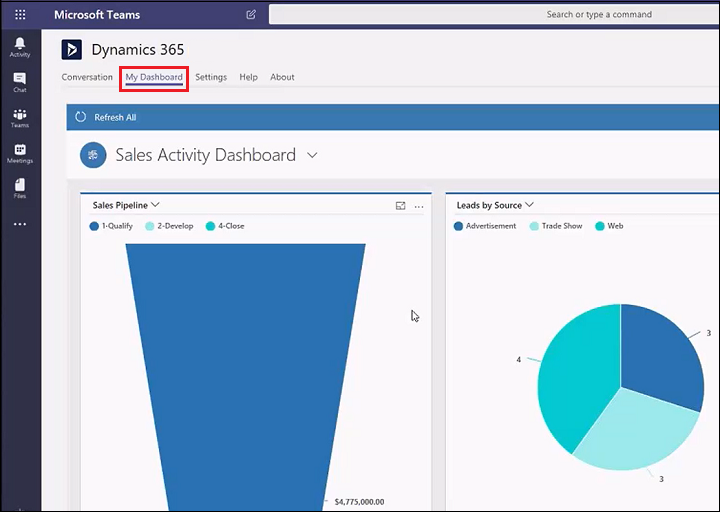
In Dynamics 365, you can:
- Start or continue Teams chats from within Dynamics 365. Message colleagues in Teams while viewing a record, without switching apps.
- Use embedded Teams Calling inside Dynamics 365 to keep Microsoft teams CRM call notes and records connected. Accept calls and link them to CRM records directly in Dynamics 365—without switching apps.
- Link Teams channels to Dynamics 365 records for record-centric collaboration. Connect a record to an existing Teams channel or create a new team/channel for that record.
- Join Teams meetings from an appointment in the model-driven app. Add or join a Microsoft Teams meeting directly from an appointment in Dynamics 365.


Which Dynamics 365 apps support Teams integration?
Teams integration is available across many dynamics 365 applications for customer engagement; below are common examples and what the integration enables.
Dynamics 365 Sales
Sales teams can collaborate on deals by sharing files, notes, and customer context directly in Teams. If you’re running dynamics 365 crm for opportunity management, dedicated Teams channels for accounts or opportunities can speed up communication and decision-making.
Dynamics 365 Customer Service
Agents can message colleagues or supervisors in real time while working a case, accelerating resolution. Share knowledge articles and best practices in Teams channels to strengthen the team’s shared knowledge base.
Dynamics 365 Field Service
Technicians can connect with experts via Teams to resolve on-site issues faster and improve first-time fix rates. Discuss and manage work orders in Teams so everyone stays aligned and can respond quickly to new jobs.
Dynamics 365 Marketing
Collaborate on campaign planning and execution in dedicated Teams channels to improve coordination. Manage webinars and virtual events through Teams and track registrations and engagement.
Dynamics 365 Project Operations (formerly Project Service Automation in some environments)
Use Teams to collaborate on tasks, share updates, and manage timelines with clear visibility. Store and share project documents in Teams so everyone works from the latest version.
Conclusion
Integrating Microsoft Teams with your CRM makes sales, marketing, and service work faster and easier—especially when Microsoft teams CRM is your system of record. It improves collaboration and productivity by unifying customer context, files, and communication in a single workspace. It reduces app switching, helping teams stay focused on customers and execution.
Use microsoft teams crm integration to reduce admin time, improve handoffs, and increase execution speed. Use Microsoft teams CRM to assess fit and map the fastest proof-first rollout—starting with the workflows that currently lose the most time to handoffs and context switching. Contact us for a free consultation.


